Vibe Entrepreneurship
For the past 6 months, I have been using agents every day to build branchpoints, a software company that helps pharma marketers make better strategic and creative decisions faster. Because the product is software, I have been using a lot of coding agents. But because I'm also building a company, I use agents for all kinds of other stuff too: legal, finance, ops, GTM, product strategy, and anything else needed on a given day to coldstart an enterprise.
Tech CEOs and Twitter hypebros like to paint agents as some epiphanic push-button experience where you spin up a jolly little swarm of digital labor, point it at all the painful and unfulfilling tasks that plague you, and like a panacea, they melt your working troubles away. Agents are indeed incredible, and they have fundamentally changed how I think about what problems can be solved and by whom. But I have found the reality of managing agents to be much more complicated than the hype would have you believe.
What follows is an account of my personal experience and earned wisdom from building with agents from October '25 to March '26. I suspect certain aspects will soon be universal to anyone who works on a computer, while others may already be comically outmoded as the tech continues its torrent pace of recursive self-improvement. If nothing else, the past 6 months have taught me firsthand how fast and how drastically what's possible is changing.
Polyrhythmic Productivity
It took me 2 solid months to get the hang of working with agents all day. And another couple months after that to realize why:
Working with agents is polyrhythmic.
In most jobs, your time is organized in a few standard ways that you repeat day after day, falling into—if not an outright groove—at least an expected rhythm of how your cognitive attention gets applied:
- Steady Beats: the tidy synchronous meeting blocks that fill your calendar in half-hour or hourlong increments. My sympathies for anyone routinely in multi-hour meetings.
- Stoccato Bleets: the Pavlovian bombardment of your e-mail/slack/text/teams/etc. that interrupts you every 2(!) minutes. We have somehow inured ourselves to this chaos, and it functions like white noise we attend to during meetings, gaps between meetings, and dinner with our family.
- Deep Work Droning: long chunks of immersive solo time where your mind can wander uninterrupted at its own set pace. Increasingly rare in my experience.
Working with agents is not like any of this at all. Agents work in loops of indeterminate length. Meaning you fire one up by telling it what you're trying to achieve. Then you set it off to do its thing. And then it comes back to you at some point thereafter with the thing done. Or because it needs your guidance. Or because it made an absolute mess of things. Or because it can't wait to confidently declare triumph, not realizing it made an absolute mess of things.
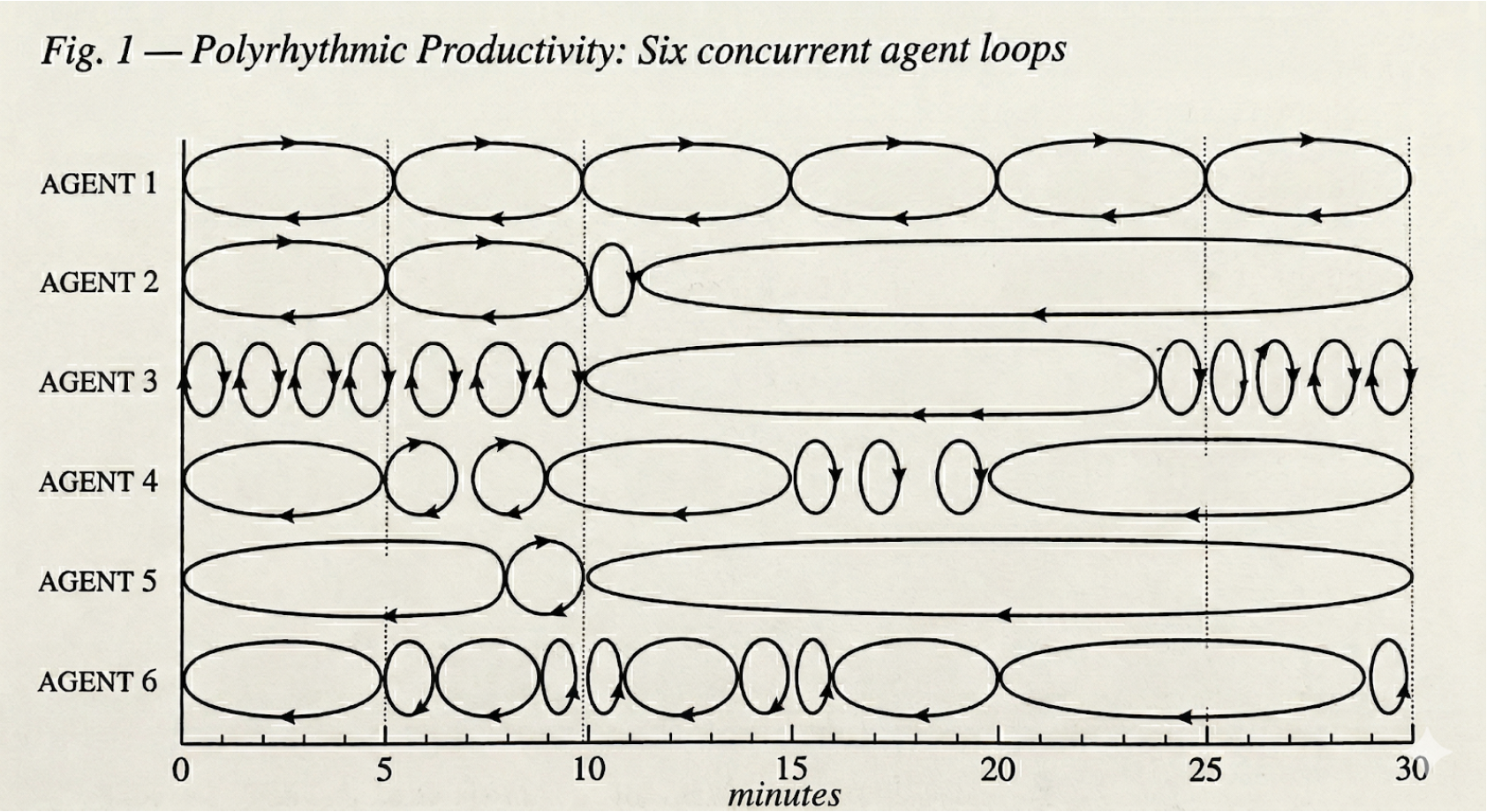
This cadence significantly alters the rhythms of work, and also the trajectory of what you can get done in a given unit of time. To me, because I never know exactly how long an agent will take to get something done, or exactly how many times I will need to interject before it will successfully finish a task, working with agents feels polyrhythmic. There's always many agents working at once, but they're never quite perfectly in time with each other, so at best your flow state is decidedly syncopated as they boomerang back to you intermittently for input.
Let me drop the metaphor and make things concrete. Right now I am running 6 agents in the background as I write this post:
- 2 are investigating production bugs
- 1 is researching a company I want to do business with
- 1 is reorganizing our company file system to be more legible for agents
- 1 is spec'ing out a new feature idea
- 1 is inside our staging deployment doing a test run of a new feature
Each one of these agents will take anywhere from 2 to 30 minutes to complete their task. Many of them will pause several times along the way for my input or steering. And in an hour's time, I am highly confident that everything on that list will be done. Let me repeat that: everything on that list will be done.
This is the value prop of agents: in an hour's time, I will have done a day or more's worth of work. But! Only if I can manage to keep them moving in the right directions. Which means every 10 minutes or so, I need to pause whatever deep work I'm trying to do and check in, review, steer, direct, re-plan, or otherwise instruct an agent towards the successful completion of its task. For every agent I have running. Now, I always have the choice to ignore them and focus on just one thing, confident that that one thing is so valuable it's worth the opportunity cost of half a dozen idle agents laying in wait for my attention. Simply imagining the horror of all that squandered productivity is too much for me to bear. (Only kinda joking).
If you're a throughput junkie like me, you mostly decide to chase max productivity at all times. But it takes a little practice to get your sea legs. I suspect it's a muscle that must be built up for most people. I was only able to effectively manage 2-3 agents simultaneously at the start. Anything over that and I'd start losing the thread of everything I was doing and generally just make suboptimal decisions across the board. But now, depending on the ambition and complexity of the tasks I have running, I can handle 6-8 without my brain turning to mush by 3pm. Maybe by summertime I'll be up to a dozen fully autonomous OpenClaws, who knows.
You Are A Fount of Invaluable Context
By Thanksgiving, I had settled into the polyrhythm. I could bob my head in time with the syncopated flow. I was dangerously close to thinking I could dance to jazz. When suddenly a new realization emerged: you can't outrun agents. No matter what I did, no matter how fast or furiously I worked, no matter how hard I vibed, I would send increasingly ambitious ideas, tasks, and needs out into the ether of latent space. And 10 minutes later they'd be back at my doorstep, waiting for my input.
This creates an ongoing tension, because you don't want to feel like you're ping ponging back and forth between agents all day babysitting them. Frankly, they don't need it. You learn very quickly how capable they are without you in the loop. With the right permissions and access, "unhobbled" agents are stunningly effective. Bitter lesson and all that.
But you also discover that there is extreme value in operating in ~10 minute loops. That value comes from the fact that agents thrive on quality context, and there is no richer context on planet earth than your human imagination and carefully articulated intent. This context doesn't exist in their training. They can't just grep it from connected systems of record. So even if you could send an agent off to reliably work for 2 hours unbroken, you might not want to, because the end output would likely be made meaningfully better if you just checked in every 20 minutes and steered it a bit. For this hypothetical 2 hour task, that's 6 extra turns of enrichment, and all it costs you is a little bit of your attention, the occasional dollop of your magical human "I want it like this." The open question naturally becomes: how much of this can I manage to do well simultaneously, hour after hour, day after day, before my brain implodes?
Managing Agents ≠ Managing People
I've seen a lot of people say if you are good at managing people, you will be good at managing agents. I don't find that to be true at all. Sure, some of the same principles apply in a theoretical sense: clear direction, helpful context, and actionable feedback all improve performance. But the pacing of how you must apply these principles to be effective with agents versus humans is completely different.
When you manage people, the pace is slow. You give them direction or feedback maybe once or twice a day—and that's if you're a really engaged, proactive manager with a reasonable team size. You definitely review their work closely if it's mission critical, but most work isn't, so you don't. You just scan whatever they show you a few times a week for the gist and then tell them what to fix and why. They figure out the rest. That figuring out is literally how they get better at their jobs. Yes, there are occasionally fires. Intense, important stuff will crop up. And sometimes you do go shoulder-to-shoulder into the night jamming on the hot thing. But mostly the job of a manager is to be a good person genuinely invested in the growth of your people, and to close the distance between you and a direct report quickly when they need your help. If you are doing your job well, you are not needed that often.
Managing agents is the exact opposite. The pace is like being a film director in the thick of principal photography. You're on set, everything is moving doubletime, and everyone wants to talk to you right now. The cinematographer needs your opinion on lighting. The lead actor wants to pick your brain about adlibbing some lines. The AD keeps letting you know we're already 30 minutes behind. Props wants to know if you like yellow or orange flowers. Wardrobe needs your sign off. Line producer needs your sign off. It feels like everyone on the entire set needs your sign off, all at the same time.
And if you miss something, or rush an answer, or get lazy and underspecify something, agents are an all-too-eager buzzsaw, absolutely delighted to run off at a thousand miles per hour diligently executing your shoddy direction. When this happens, it's usually best to just scrap things and start over instead of trying to salvage. No feedback. No "nice try, try again." All that mushy human stuff above about managing with understanding and grace? Not needed here. I am mercenary in my agent interactions. I tell them to do the thing and they do the thing. If they have questions, they'll certainly ask. I do still say please and thank you though because, hey, you never know.
All Killer, All the Time
Another (wildly underdiscussed!) phenomenon of working with agents is that you no longer have dumb conversations. Every agent interaction is all killer, no filler, all the time. They immediately grasp what you're after and start building it out in intelligent ways you didn't imagine or anticipate, no matter how half-baked the idea you rambled half-caffeinated into WisprFlow. There are no Slack pings asking "Where's that file again?" or meeting requests to recap the recap meeting. It's both refreshing and mentally exhausting to constantly be fielding questions that get to the heart of the most significant and consequential strategic, creative, or executive-level choices that must be made to unblock the work and move something forward or meaningfully improve it.
As you might have guessed, constantly stretching your brain in this way hurts! But if you are working on problems that you're interested in solving, it's also absolutely thrilling. You fall into a polyrhythm of context switching in ~10 min increments across all hard things with all geniuses all day long, where you're constantly throwing your fastball at every problem on your plate. It becomes flatly addicting to stack 12 hour days where you check off a week's worth of work.
All this aggressive context switching is a choice, mind you. You could very easily, very effectively just work with a single agent every day and be leagues more productive than you otherwise would be. Nothing wrong with that. In fact, I recommend that's how people start, and build up slowly from there.
I recognized a lot of my early struggles working with agents in the excellent HBR study on how AI is intensifying work. You absolutely cannot do consistently great work working at this pace all the time. You absolutely do need to pause, take a long lunch, hang with your kids, walk the dog, play guitar, text your friends memes, touch grass. You absolutely do need to forget the 6 background agents running right now and finish writing this damn post. I couldn't agree more that the single most effective way to use agents is to use pen and paper first to sketch out whatever's in your head, clearly organize your ideas and intent all by yourself or with your team, and then and only then hop into the tech to help you build it out. Hard agree on all fronts.
Here's where my experience differs from the Harvard study: you get used to it. Learning new things is hard. It is scientifically proven to tire you out. And working with agents is crazy new; it's something very few people in the world have done yet in a mundane, day-to-day sort of way. It takes practice, but you do get better at it. Working with agents is like anything else: success is not a lightswitch you just flip. Gains are incremental, but they do compound.
The Bottleneck is You
"The bottleneck isn't AI capability; it's human imagination on how to use it." — Hyperproductivity
Once you lock into your agentic polyrhythm, things begin to accelerate. You are routinely getting a lot more things done and done well. This is addicting. You get more ambitious. You start just trying things to see if it'll work. Half the time it does. When it doesn't, no sweat. Because you know if you really wanted to put in the elbow grease to get it to work, you could. Overall, you start to think more grandly about what's possible.
Breaking through this threshold has been particularly fun, because you start rapidly ascending upwards through abstraction layers, designing ways of working where you are as far removed from anything agents can do without your help as possible, but still firmly the director of all things at all times, extending your intent and throughput in ways that feel at times downright superhuman.
Eventually, you start seeing everything as a system of loops that you control. You daydream in this meta, dissociative sort of way: "How far can I remove myself from the execution of everything I'm doing without things degrading to a point where the delta between what agents could do on their own versus what they could do with my hands-on involvement becomes unacceptable?" This is an infinite game that I have found myself increasingly preoccupied by.
What's Left Is the Hard Part
The image below lives rent-free in my head. It is from Erik Brynjolfsson's wonderful essay "The Turing Trap", and politely redirects our attention away from the anxieties of impending automation to reveal the much larger and much more rapidly expanding surface area of opportunity that applied tech makes possible:
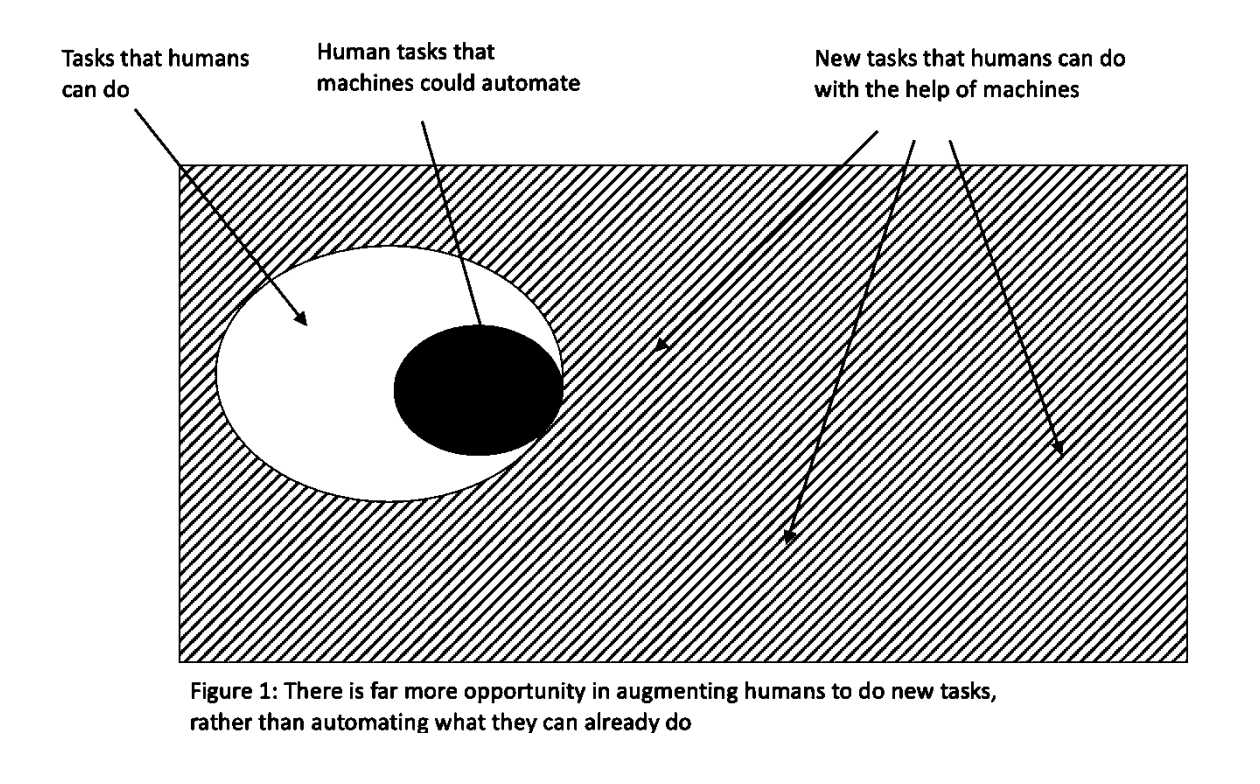
Which is all well and good until you watch Claude Cowork one-shot what you spent the first 3 years of your career learning how to do by hand and can't sleep for a week fever-dreaming about a 20% unemployment rate.
Luckily, the more I work with agents, the more my fears allay and I believe Mr. Brynjolfsson to be right. I have found that no matter how much of my work I automate, there is always more for me to do. And the work that's left is much more interesting, difficult, and high leverage than whatever I managed to systematize away. I have never relied more on my imagination and ability to make decisions than I have now that it feels like I can build anything. Which stands to reason: when you can speak any idea into existence, deciding what to do becomes the hardest part.
Alfred Hitchcock used to say that shooting a film was boring, because by the time he got to set, he'd already worked everything out in his head. The creative problems had already been solved. Shooting the storyboards was merely rote execution. This is how I feel working with agents now. I dream up what I want to do, plan exhaustively on how to do it, and make tons of iterative decisions along the way on how I think it should come to life. Once I'm happy with a plan for a given unit of work, I let the agents rip, and they've gotten so good, whatever they've made mostly suffices. Or I can quickly get it to with a little review and follow-up. I am speaking specifically about software, but fully believe coding agents are a bellwether for all knowledge work. Very soon everyone who works with computers will spend their days making plans, directing agents, and reviewing work. The executing will largely be offloaded. But there will still be loads to do because nothing happens unless you, the human, say "let's do this, in this way." We will remain the animating force.
Which means the real bottleneck isn't how many terminals you can manage simultaneously. It's how creative you can be in your application of this technology to bring your imagination to life. For me, I have never felt more time impoverished, because I have never felt more capable. So many ideas I have now are feasible and actionable in a way that they simply weren't before. It's exciting. It's overwhelming. And it changes every day.
Yes, things are moving very quickly. And are guaranteed to move faster still. Today's jobs will be tomorrow's tasks. We'll all move up successive abstraction layers together. What's happened in software development will come for every other white collar job too. This transition will be messy and nonlinear. There will be a lot of trial and error because there is no right way yet. And there may never be. We are all in R&D now—researchers, tinkerers, experimenters, learners. This is perhaps the most enduring truth from my first 6 months of agent-native working: play is a precursor to utility. You simply have to screw around with this technology to see if it'll do the thing you want it to do. And adjust from there. So far, I have found that process to be a lot of fun.
Special thanks to my friends who gave helpful feedback on early drafts of this post.